Eat to Cheat by Ngaire Hobbins
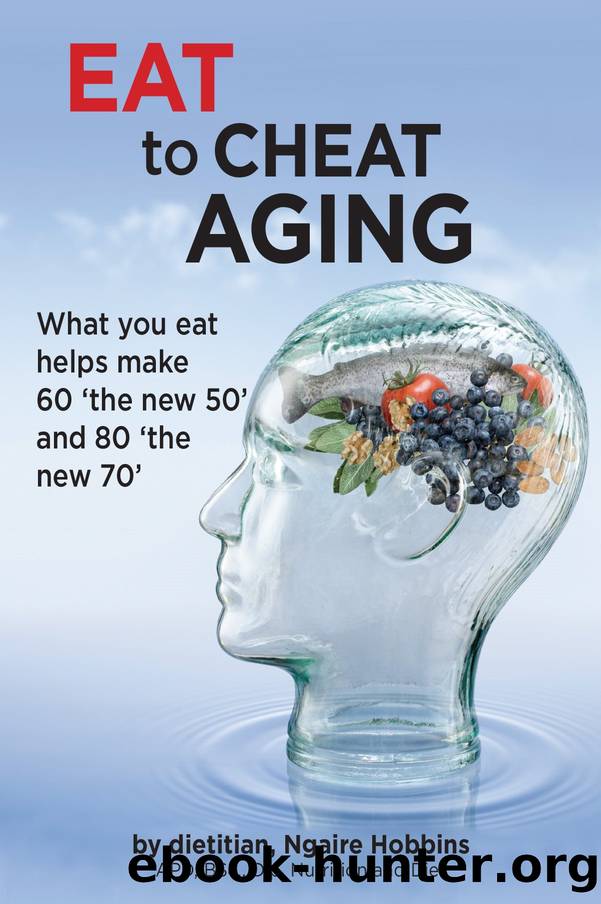
Author:Ngaire Hobbins
Language: eng
Format: epub
Publisher: Ngaire Hobbins
Published: 2015-12-15T00:00:00+00:00
Getting enough of the right stuff
When you are well, getting the protein you need is usually as easy as building your meals around a good protein food and adding those multicoloured vegetables, grains and fruits â at least at most meals. The exact amount each person needs depends on your weight and health so it's just not possible here to give an exact guide for each individual. Not only that, but while most experts agree that the amounts younger adults are advised to eat are too low, it will be a while before they all agree on exactly what to recommend for older folks.
For those who are mostly well, an amount of around 1.2 grams of protein for every kilogram you weigh (or 0.55g per pound weight) is often suggested as the ideal level (some researchers suggest 1.5 grams per kilogram per day - 0.68g per pound). That means 60 to 80g a day, spread as evenly as possible through the whole day, will usually be enough.
But there are lots of times when you are:
recovering from illness,
heading for surgery or have just had an operation
immobilized (or have recently been) due to illness
losing weight (and therefore muscle)
exercising to boost your muscle
moving into later old age
At these times you could need 15 or 20 grams more protein each day, the equivalent of an extra
2 small chops
or 2 eggs
or about 4 slices of wholemeal bread
or 2 cups of cooked rice
or 2 cups of lentils
If that sounds an impossible feat or you are struggling to eat enough, high protein drinks or a special supplement drinks (see Chapter 8) can make life easier.
Start to boost your protein intake as soon as you possibly can after illness or surgery to help your recovery â even if you are still laid up.
Don't always expect to be able to see improvements in the mirror but remember than an adequate protein intake will certainly help you regain strength and ability, as well as supporting your body in all those other important internal functions you've read about earlier in this book.
I don't eat meat â will I get enough protein?
If you have gradually cut down on animal protein foods but are not necessarily committed to vegetarian eating, you really need to reconsider your choices as you move into your older age. As you've heard already, it's generally much easier to get enough protein from animal foods because you can get what you need from smaller amounts of food, not to mention the easy-to-access iron, zinc, selenium and vitamin B12 they supply.
If you have cut out meat but still eat dairy foods and eggs then you may need to take iron and maybe other supplements, but you shouldn't have problems getting the protein you need.
But if you have chosen to be vegetarian, then you need to be extra vigilant about the protein you eat, as well as the nutrients you need. Nuts, pulses (lentils and beans), seeds, grains and soy products such as tofu are all good options. You can also take high protein supplements made from soy, rice or other plant proteins like pea protein.
Download
This site does not store any files on its server. We only index and link to content provided by other sites. Please contact the content providers to delete copyright contents if any and email us, we'll remove relevant links or contents immediately.
| Administration & Medicine Economics | Allied Health Professions |
| Basic Sciences | Dentistry |
| History | Medical Informatics |
| Medicine | Nursing |
| Pharmacology | Psychology |
| Research | Veterinary Medicine |
Periodization Training for Sports by Tudor Bompa(8278)
Why We Sleep: Unlocking the Power of Sleep and Dreams by Matthew Walker(6729)
Paper Towns by Green John(5195)
The Immortal Life of Henrietta Lacks by Rebecca Skloot(4593)
The Sports Rules Book by Human Kinetics(4396)
Dynamic Alignment Through Imagery by Eric Franklin(4220)
ACSM's Complete Guide to Fitness & Health by ACSM(4061)
Kaplan MCAT Organic Chemistry Review: Created for MCAT 2015 (Kaplan Test Prep) by Kaplan(4015)
Introduction to Kinesiology by Shirl J. Hoffman(3777)
Livewired by David Eagleman(3777)
The Death of the Heart by Elizabeth Bowen(3626)
The River of Consciousness by Oliver Sacks(3607)
Alchemy and Alchemists by C. J. S. Thompson(3526)
Bad Pharma by Ben Goldacre(3429)
Descartes' Error by Antonio Damasio(3281)
The Emperor of All Maladies: A Biography of Cancer by Siddhartha Mukherjee(3165)
The Gene: An Intimate History by Siddhartha Mukherjee(3100)
The Fate of Rome: Climate, Disease, and the End of an Empire (The Princeton History of the Ancient World) by Kyle Harper(3068)
Kaplan MCAT Behavioral Sciences Review: Created for MCAT 2015 (Kaplan Test Prep) by Kaplan(2988)
